
4. Preview CSV impact without importing it
Identify affected consumers before importing a change.
Goal: Identify affected consumers before importing a change.
Before you start: Original Targets and Consumers, Candidate.csv and nullable-handles.
The idea you will use
Current findings describe assets. Comparison predicts the impact of candidate keys within the selected scope.
Predict before running
Does comparing a CSV without T1 delete T1 from the asset?
Build and check
Check which consumers would lose their destination before importing a candidate table through your normal workflow.
- Select
TargetsandConsumersagain, click Use selected DataTables, and loadFixtures/nullable-handles.json. - In the CSV panel, choose
Targetsas the candidate destination table and selectFixtures/Candidate.csv. - Once both inputs are selected, wait for the comparison to finish. The candidate CSV removes T1.
- Check the two current example errors and two additional
ROWTETHER-ROW-REMOVEDwarnings for C1 and C2, which use T1. - Open
Targets: T1 should still be there. The preview reads row keys and headers; it does not import the CSV or run import hooks. - Click Clear comparison to return to the findings from the current tables.
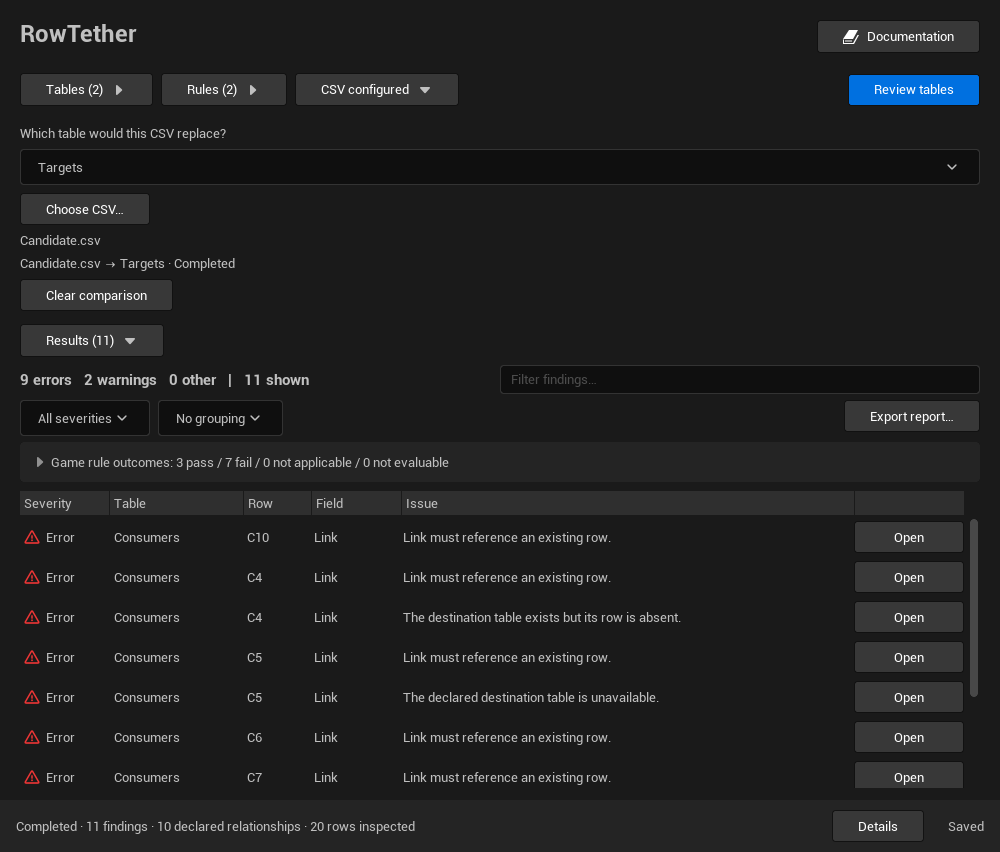
Do not read the warnings as if the row had already been removed. Review every consumer in scope before deciding whether to import the file.
If the comparison does not start, check that Targets is in the selected table list, is the candidate table and the CSV still has the Name header. Do not import Candidate.csv.
Check your reasoning
See the explanation
No. Comparison does not import. C1 and C2 would be affected; C4 and C5 remain current errors.
Your turn: Record current issues separately from predicted impact and verify that Targets still contains T1.
Ready to continue when: you can support a decision without confusing those two sets.
Progress is saved only in this browser and carries over when you switch language.